IN BRIEF
Saving is easier to understand when it has a purpose and a place in the budget. Start by finding what is genuinely available after commitments, then build a repeatable transfer and review routine. A plan that survives an ordinary week is more useful than a dramatic cut you cannot maintain.
Find the money before setting the target
Review income and spending before deciding how much you should save. Moneysmart recommends using a budget to identify regular income, essential costs and possible reductions. Tracking transactions also helps reveal unused subscriptions and occasional costs that a remembered estimate misses. [2][3]
The useful number is not the balance on payday. It is what remains after bills, everyday costs, minimum repayments and provisions for later expenses. If the account contains money for an insurance renewal, moving it into a holiday goal does not create new savings. It simply changes which future cost is underfunded.
Start with recurring costs you can actually change
Moneysmart’s saving guidance covers energy, insurance, food and fuel, phone and internet, and borrowing costs. It also warns that insurance comparisons should consider cover, not price alone. Use that same principle across services: compare what you need, the ongoing price, any conditions and switching costs. [1]
Make a short action list rather than trying to renegotiate everything in one afternoon. Cancel something you no longer use, check whether a plan still fits, or compare a renewal before it rolls over. Record the confirmed change in the budget. A quoted saving that is never implemented does not increase the amount available for your goal.
Give the goal a price and a date
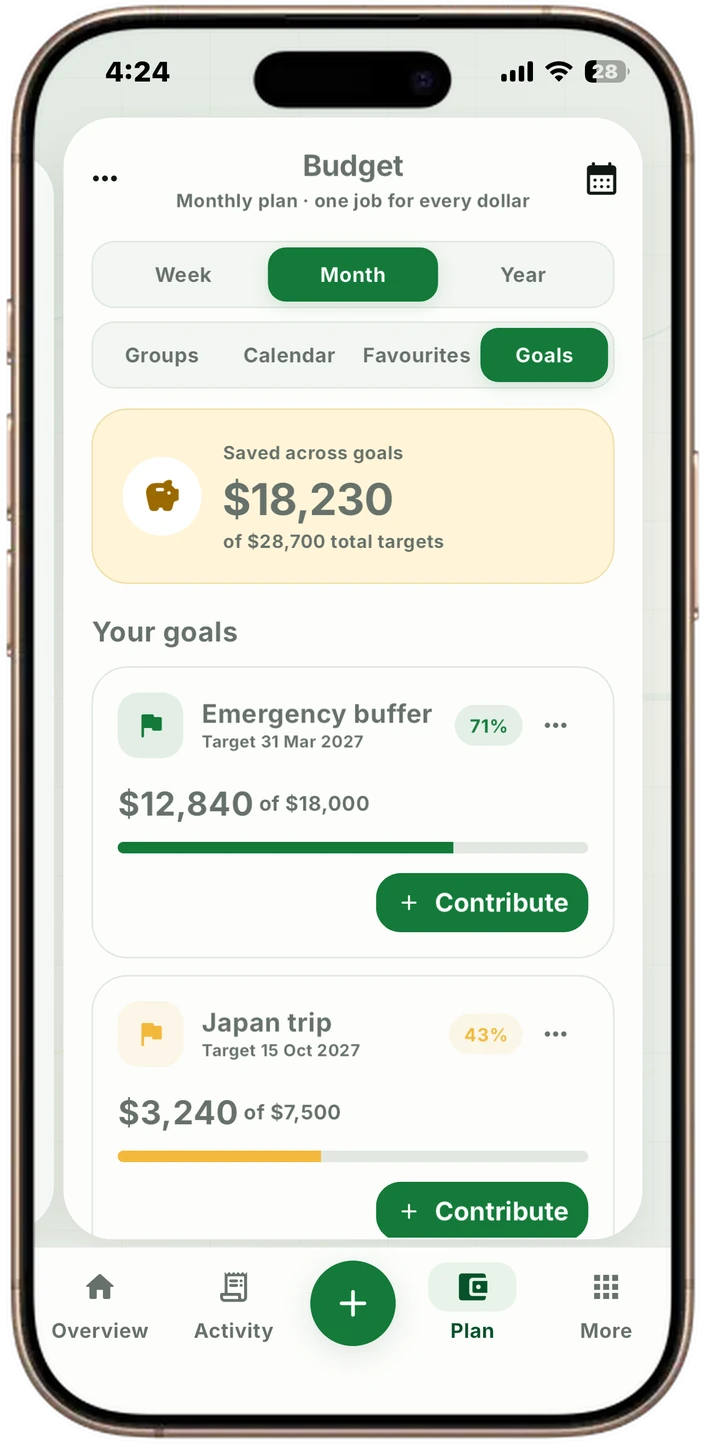
A named goal is easier to plan than an instruction to “save more”. Record what it is for, the target amount, money already set aside and the date you would like it available. Then count the contributions remaining. If the required contribution does not fit the budget, change the amount, deadline or goal rather than relying on a future windfall.
Moneysmart recommends revisiting goals when income, expenses or priorities change, and breaking a distant goal into smaller steps. [1]
Separate the jobs your savings are doing
| Purpose | What it prepares for | Useful question |
|---|---|---|
| Emergency fund | An urgent or unexpected cost | Could I access this when other money is unavailable? |
| Sinking fund | A predictable bill or replacement | How much is due, and when? |
| Personal goal | A planned purchase or experience | What contribution and deadline fit my priorities? |
You can represent these jobs with separate accounts, bank savings buckets or clear records. The important thing is that the same dollars are not promised to several goals. If a single savings account contains all three, keep a breakdown of what belongs to each purpose.
Moneysmart suggests keeping savings separate from everyday spending to make progress easier to track and reduce the temptation to use them casually. Compare account fees and conditions before adding accounts. [1]
Automate an amount that respects your cash flow
A scheduled transfer around payday can remove the need to make the same decision repeatedly. Moneysmart describes regular transfers and, where available, splitting pay as ways to support saving. Automation should follow a realistic budget and the actual arrival of income. [2]
Choose an amount that leaves enough for commitments. If work hours vary, a fixed transfer based on the best week can create trouble in the next one. A small baseline contribution plus a deliberate top-up after a stronger pay may be easier to manage. That is a planning option to test, not a rule that every household must follow.
Measure progress without counting transfers as income
A transfer between your own accounts changes where money sits, not how much you earned. Track contributions, withdrawals and the goal balance separately from wages. This makes it easier to see whether the goal grew because you saved more, received interest or simply moved an existing balance.
Check progress on a schedule that supports the habit without making every fluctuation feel urgent. A payday check can confirm the transfer arrived; a monthly check can compare progress with the deadline. If a goal needs to change, record why. An honest adjustment is more useful than keeping an unrealistic target on screen.
Recover from a pause without trying to punish the gap
Moneysmart explicitly recognises that saving sometimes stops. Its guidance is to restart with an amount that fits the situation now rather than trying to catch up all at once. That is particularly relevant after a move, reduced hours, a medical cost or using an emergency buffer for its intended purpose. [1]
First make sure the next essential payments are covered. Then decide whether the original target and deadline still make sense. A smaller contribution is not automatically a failure; borrowing to maintain an impressive savings streak can leave the overall position worse. If the shortage is ongoing, the question may be support rather than another savings tactic.
If essentials or repayments are not manageable, contact the National Debt Helpline on 1800 007 007. Financial counselling is free and confidential. Moneysmart lists phone hours of 9:30am to 4:30pm, Monday to Friday, and live chat from 9:00am to 8:00pm, Monday to Friday. Check the service website for availability. Legal action needs prompt legal advice, not just a different budget. [6]
Frequently asked questions
How much should I save each payday?
Start with your actual surplus after commitments and future bills. Then compare that with the amount required for your goal. There is no single percentage that fits every household. A contribution you can keep without missing essentials is more useful than an arbitrary target.
Are round-ups enough to build savings?
They can support a habit if your bank offers them, but they do not replace a plan for a specific target and deadline. Check how they work and do not make extra purchases merely to generate round-ups.
Should I save or repay debt first?
That depends on the costs, required repayments, emergency needs and consequences of missing payments. Cover priority commitments and seek personalised help if debts are unmanageable. A budget can show the trade-off, but it cannot choose the right answer for every situation.
Sources & further reading
Sources checked 30 September 2026. Follow the linked source for current rules and eligibility.
- ASIC Moneysmart — Simple ways to save money
- ASIC Moneysmart — How to start saving
- ASIC Moneysmart — Track your spending
- ASIC Moneysmart — How to do a budget
- ASIC Moneysmart — Save for an emergency fund
- ASIC Moneysmart — Financial counselling
How this guide was prepared
Published by VULT and prepared with AI assistance using the sources linked above. The explanations and fictional examples are original educational writing; they are not personal financial, tax, legal or credit advice. No independent professional review is claimed. Where sources differ, the relevant official authority takes precedence for current rules. Reading time is estimated at 200 words per minute.
Found something that needs correcting? Send VULT feedback, including the guide title and the source you believe needs checking.